

News Center
NEWS CENTER
26
2021
-
11
Is the Chinese gallnut in the Hubei & Hunan calendar a fruit of Rhus chinensis?
Author:
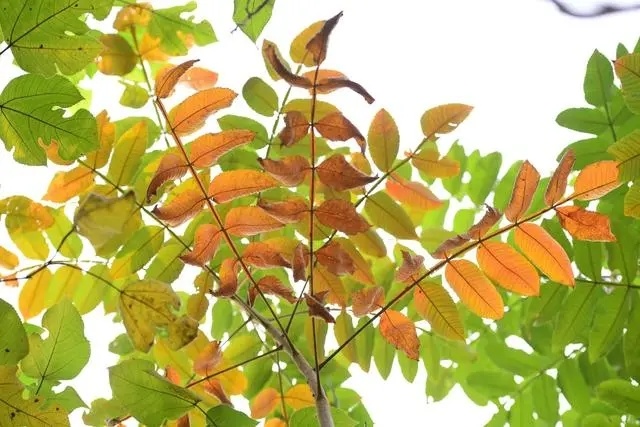
In the mountains, forests, valleys, and valleys, the salt tree is probably the most common red leaf tree.
It is not as popular as common autumn and winter colored leaf trees such as maple, Chinese tallow, ginkgo, and Chinese gooseberry. The reason for this is probably because it is not very delicate enough. The tree shape is messy and not straight, and the leaf axes and petioles look fluffy. Even the leaves dyed red by the cold wind are not as beautiful.
But Salicornia is known for its uniqueness.
Firstly, let's talk about "salt". The reason why Rhus chinensis is called Rhus chinensis is because it has "salt" on its body, which comes from its fruit.
During the summer and autumn seasons, the fruits of Rhus chinensis are coated with a white crystalline substance resembling table salt, as if the fruit is sweating when heated, and the sweat evaporates. This substance not only looks like salt, but also tastes salty when eaten.
Previously, some people scraped off salt frost as plant salt for consumption. But strictly speaking, it is a chemical concept of salt, not the salt used in cooking. Although it can make food salty, it cannot replace salt to provide the sodium element that the human body needs.
The economic value of Rhus chinensis cannot be underestimated.
Salicornia is one of the host plants for the gallnut aphid. In spring, after Salicornia grows leaves, aphids fly from the winter moss to the Salicornia tree, stimulating the proliferation and swelling of plant leaf tissue cells to form galls ǐ Ng].
What is a gall? Is it the egg of an aphid? No, actually it's like a house for aphids.
This aphid house grows and becomes a hollow shell as the number of aphids breeding inside increases. Harvest in autumn, boil it in boiling water or steam it until the surface turns gray, kill aphids, take it out, dry it, and it becomes a precious gallnut.

Galla chinensis is a precious Chinese medicinal herb that looks like the fruits on a tree. In ancient times, people mistakenly believed that galla chinensis was the fruit of Rhus chinensis. In the Song Dynasty's "Kaibao Bencao", galla chinensis was recorded in the grass section, and it was not until the Ming Dynasty that Li Shizhen had a scientific understanding, In the Compendium of Materia Medica, it is included in the insect part as follows: "The odor is sour and salty, astringent, cold, and non-toxic. It is mainly used to regulate the lungs and reduce fire, dissolve phlegm and drink, stop coughing, quench thirst, night sweats, vomiting, blood loss, and chronic dysentery..."
Galla contains galla tannin. Before modern chemical industry, galla was necessary for tanning soft leather, but now this function has been replaced by chemical raw materials. Gallnuts are also raw materials for manufacturing plastics and blue ink, and can also be used as dyes.
In Xiangxi, Yongzhou and other areas of our province, people plant and cultivate gallnuts, deliberately causing damage to the branches of Rhus chinensis, resulting in swelling of plant tissue and ultimately the formation of gallnuts, which is also a major industry.
【 Small Business Card 】
Salicornia is a deciduous small tree or shrub belonging to the family Rhus, and can reach a height of up to 10 meters; Branchlets are brownish brown, with a single pinnate compound leaf. The leaf axis has wings, and the leaves are polygonal, ovate or elliptical, ovate or oblong. The leaflets are sessile. Flowering from August to September, fruiting in October.
Except for Northeast China, Inner Mongolia, and Xinjiang, it is distributed in all other provinces and regions in China. Born in sparse forests or shrubs on sunny slopes, valleys, and streams below an altitude of 2700 meters.
Rhus chinensis is a major economic tree species in China, which can be used as a raw material for pharmaceuticals and industrial dyes. Its skin and seeds can also be pressed for oil. In landscaping, it can be used as a tree species for observing leaves and fruits. Honey and flour are both abundant, making it a good source of honey for plants. Roots, leaves, flowers, and fruits can all be used as medicine, with the effects of clearing heat and detoxifying, relaxing tendons and activating collaterals, dispersing blood stasis and stopping bleeding, astringent intestines and stopping diarrhea. It is also the most common pioneer tree species in wasteland, with strong tillering and rapid growth. It is a species that is difficult to remove in landscaping and forestry production.
Related News

Contact Information
Address: No. 26, Industrial Park, Hongjiang District, Huaihua City, Hunan Province
Zip Code: 418200
Telephone:86 745 7695222
Mailbox:sales@bybiotech.com

QR code
©COPYRIGHT Hunan Gallia Biotechnology Co., Ltd. ALL RIGHTS RESERVED Powered by 300.cn
SAF Coolest v1.3.1.1 设置面板 NEYSX-ZFEF-OVSEE-ZXW
无数据提示
Sorry, the current column has no content for the time being.!
You can view other columns or returnHome Page